







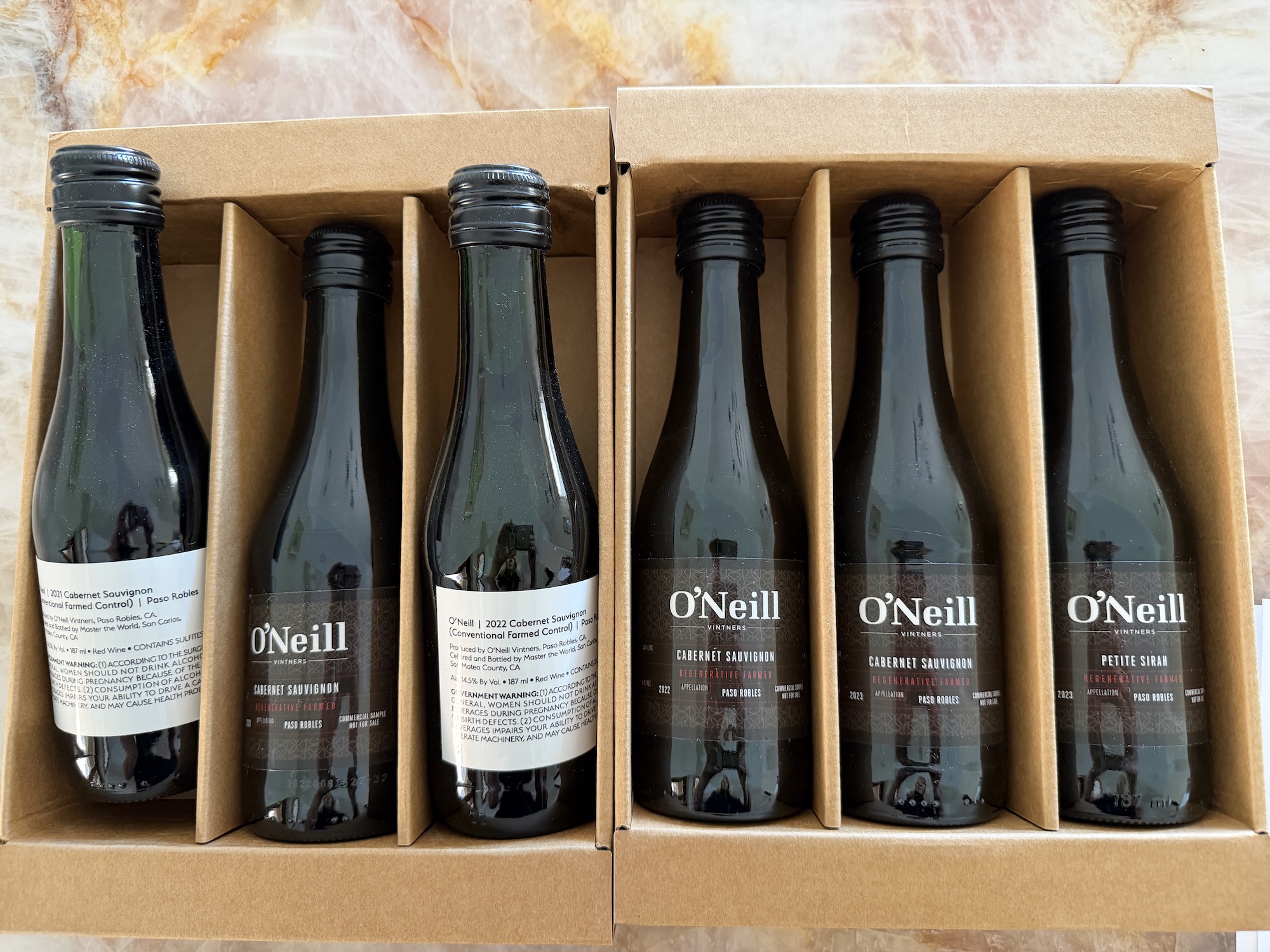
I was recently offered the opportunity to try the same wines from Robert Hall in Paso Robles that were made two different ways: Regenerative Organic and Conventionally Farmed. If you know me you know that I have the unpopular opinion that I don’t care how the wine is made, organic or not, I just want it to taste good. So, being offered these wines to try side by side was a special treat for my palate, and would finally answer the question: would one taste better, worse, or the same?
Below I will share the wines I tried and my tasting notes. Below that is an excerpt of the press release about the project.
The Wines
Each sample was aerated for 15 minutes before tasting as suggested:
One: (comparison)
Regenerative Organic Farmed 2021 Cabernet Sauvignon
Blackberry-colored, opaque; blue to black fruit, mint, earth, crushed leaves, and dark chocolate all on the nose; on the mouth there were notes of bright red to black fruit, tingly mouthfeel, light tannins with medium spice. I wanted more dark fruit and tannins.
Conventionally Farmed 2021 Cabernet Sauvignon
Blackberry-colored, opaque; creamy/rich and well-integrated dark fruit, no mint, milk chocolate, lighter earthy notes, and medium spiciness on the nose; on the taste I noted lots of dark fruit, lots of spice, light tannins, and some of that tingly mouthfeel found on the organic wine.
Conclusion: tasting side by side I noted only slight differences. As my palate prefers tannins and spice I would probably reach for the conventionally farmed wine.
Two: (comparison)
Regenerative Organic Farmed 2022 Cabernet Sauvignon
Very dark berry colored, opaque; notes of stewed red fruit, dried green leaves, and red earth on the nose; followed by flavors of bright red fruit: cherry, raspberry, and strawberry, followed up by drying tannins and a long length.
Conventionally Farmed 2022 Cabernet Sauvignon
Very dark berry colored, opaque; notes of sweetened black fruit jam, cocoa, tree bark, and sweet pipe smoke on the nose; got some of those same aromas on the taste – the dark fruit jam and cocoa – as well as a lot of spice and tannins.
Conclusion: Liking the conventional fruit on this one too. Looking forward to now trying the two regenerative organic farmed wines on their own.
Three: (Regenerative Organic Farmed only)
Regenerative Organic Farmed 2023 Cabernet Sauvignon
Very dark burgundy, opaque; rich dark fruit notes on the nose, as well as green vegetable, and forest floor; the taste reminded me of rich dark chocolate, black licorice, espresso, and slight amount of eucalyptus. Dark, tannic and with a long finish. This young Cab ended up delivering a nice punch.
Regenerative Organic Farmed 2023 Petite Sirah
The darkest one yet, very purple and opaque; blueberry, blackberry, black licorice, and some minerality on the nose; thoughts of sweet blueberry right off the start, followed by a very dry mouthfeel due to super firm tannins and oak, and lingering flavors of blackberry, cocoa, medium spice and the longest finish yet. Very nice.
Conclusion: Apparently I liked the organic wines – the 2023 Cabernet Sauvignon and the 2023 Petite Sirah – when tasted them on their own and not against a conventionally farmed wine. But I preferred the conventionally farmed wines – the first two I tasted – when I tasted against the organic. So, for me, I have to admit that though I don’t feel biased against organic wines, I just might be! This was all so interesting. I feel that I need to give these organically farmed wines some more real estate in my glass.
Excerpt of press release that ran on this website on March 18:
Paso Robles, Calif., – Robert Hall Winery, a leader in the Paso Robles American Viticultural Area (AVA) and a Regenerative Organic Certified® winery, is celebrating the one-year anniversary of the Regenerative Viticulture Foundation (RVF)’s One Block Challenge…
The initiative, launched by RVF in partnership with Robert Hall in 2025, invites grape growers to dedicate one vineyard block for at least one year to regenerative practices, enabling growers to test regenerative practices to learn farming practices and outcomes. Robert Hall Winery, owned by O’Neill Vintners & Distillers, is part of a growing group of Paso Robles AVA leaders-including Tablas Creek, MAHA Estate, Booker, and Halter Ranch-that are driving the adoption of sustainable, climate-resilient farming practices in the region. At the forefront of this effort, Robert Hall Winery has conducted the region’s only living regenerative organic viticulture case study, showing a side-by-side comparison of regenerative organic and conventionally farmed vineyards to rigorously evaluate impacts on soil health, carbon sequestration, and fruit and wine quality.
The study spans 40 acres of Robert Hall estate vineyards and tracks a comprehensive suite of vineyard and winemaking metrics, including soil carbon, microbiology, biodiversity, yield, grape chemistry, phenolics, and sensory outcomes…
To highlight the influence of Regenerative Organic Certified® farming and Robert Hall’s pioneering role, ROC Tasting Kits have been created and are available to both media and trade. The kit includes two types of samples: “conventionally farmed” wines made from sustainably farmed grapes and a counterpart wine made from Regenerative Organic Certified® grapes, allowing for a direct comparison tasting experience across three vintages…
Eve Bushman has a Level Two Intermediate Certification from the Wine and Spirits Education Trust (WSET), a “certification in the first globally-recognized course” as an American Wine Specialist ® from the North American Sommelier Association (NASA), Level 1 Sake Award from WSET, was the subject of a 60-minute Wine Immersion video (over 16k views), authored “Wine Etiquette for Everyone” and has served as a judge for the Proof Awards, Cellarmasters, LA Wine Competition, Long Beach Grand Cru and the Global Wine Awards. You can email Eve@EveWine101.com to ask a question about wine or spirits. Follow on Instagram and Facebook.